![[DramaTriangle.jpg]]
`Concepts:`
`Knowledge Base:`
## **The Three Roles of the Drama Triangle**
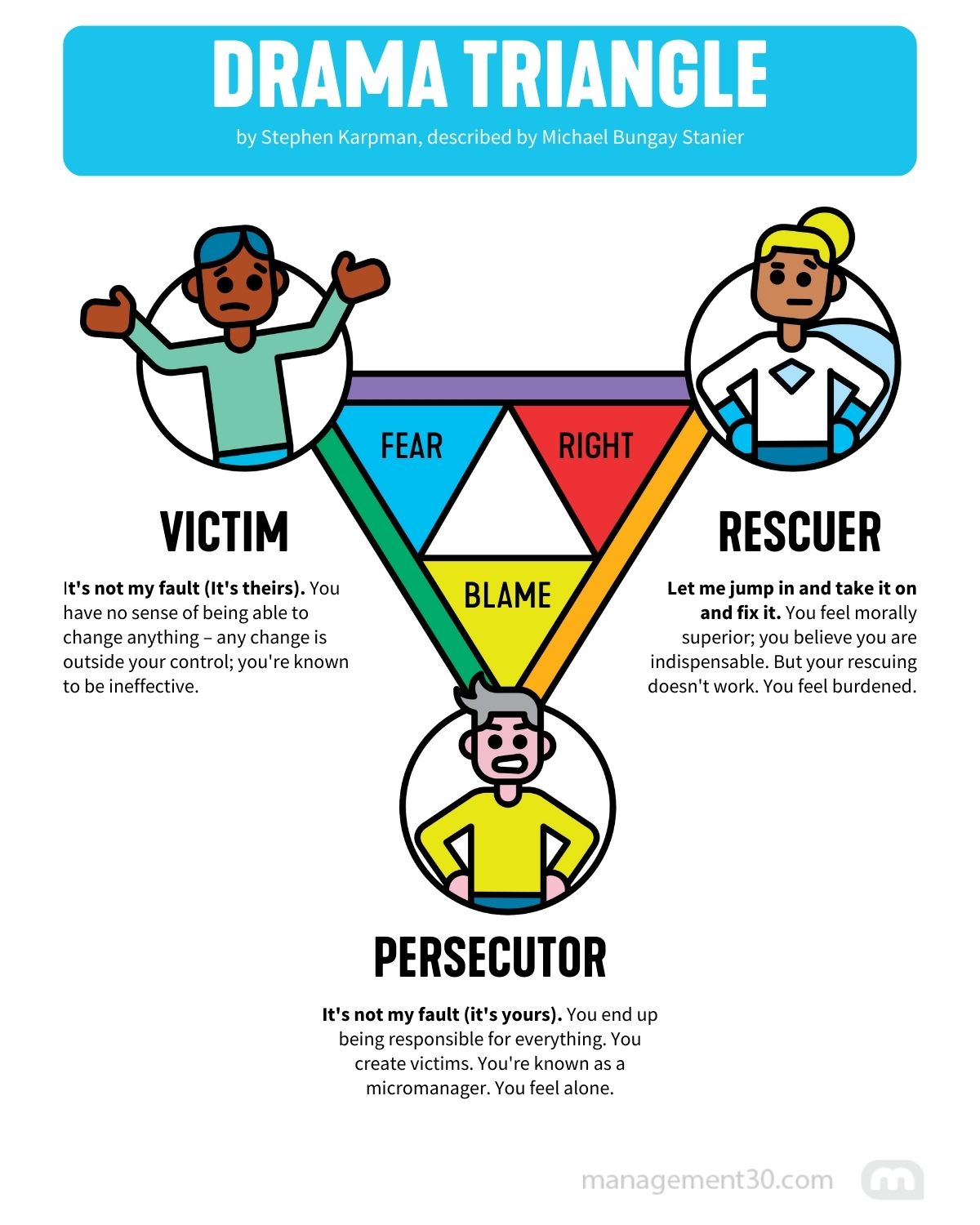
The Drama Triangle, [first described in the 1960s by Stephen Karpman](https://karpmandramatriangle.com/), a U.S. therapist and co-founder of transactional analysis, identifies three primary roles: the Victim, who feels oppressed and helpless; the Persecutor, who blames and criticizes; and the Rescuer, who tries to save the day without being asked. These roles are not fixed; individuals can shift between them in various situations. Understanding these roles offers a fundamental insight into conflict dynamics, helping identify behavioral patterns within teams and organizations.
In his book “[The Coaching Habit](https://www.mbs.works/coaching-habit-book/),” Michael Bungay Stanier, an award-winning author, coach, and speaker, describes these roles as follows:
| | | | |
|---|---|---|---|
||**Victim** <br>|**Persecutor** <br>|**Rescuer** <br>|
|**Core Belief**|“My life is so hard; my life is so unfair. Poor me.”|“I’m surrounded by fools, idiots, or people less good than me.”|“Don’t fight, don’t worry, let me jump in and take it on and fix it.”|
|**Dynamic**|“It’s not my fault (It’s theirs).”|“It’s not my fault (it’s yours).”|“It’s my responsibility (not yours).”|
|**Benefit of playing this role**|You have no responsibility for fixing anything; you get to complain; you attract rescuers.|You feel superior and have a sense of power and control.|You feel morally superior; you believe you are indispensable.|
|**Price paid for playing the role**|You have no sense of being able to change anything – any change is outside your control; you’re known to be ineffective. And no one likes a whiner.|You end up being responsible for everything. You create victims. You’re known as a micromanager. People do the minimum for you and no more. And no one likes a bully.|People reject your help. You create victims and perpetuate the Drama Triangle. And no one likes a meddler.|
|**You feel stuck because**|You have no power or influence. You feel useless.|You don’t trust anyone. You feel alone.|Your rescuing doesn’t work. You feel burdened.|
[](https://management30.com/wp-content/uploads/2023/11/drama-triangle-explained.jpg)
Considering [McGregor’s Theory X](https://management30.com/blog/theory-x-y/), it’s interesting to note that the Persecutor feels validated in their view of the world (“the others are lazy, stupid workers”), further reinforcing the situation. However, we aim to avoid conflicts and break free from the Drama Triangle rather than support it.
To escape this cycle, it’s important to understand why Drama Triangles form.
## **What Causes the Drama Triangle?**
The Drama Triangle often originates from unmet emotional needs, a lack of assertiveness or self-awareness, and poor communication skills. Additionally, the team or organizational culture can foster it. A culture of blame, fear, or unresolved conflicts encourages the Drama Triangle, highlighting situations where [psychological safety](https://management30.com/blog/psychological-safety/) is lacking.
## **The Drama Triangle in Leadership**
In leadership, the Drama Triangle manifests as toxic behaviors such as blame, avoidance of responsibility, and [micromanagement](https://management30.com/blog/micromanagement/). Leaders can also fall into the roles of Victim, feeling overwhelmed by challenges; Persecutor, resorting to authoritarian tactics; or Rescuer, micromanaging their team to ‘save’ them. This behavior hinders team growth, innovation, and collaboration.
When leaders find themselves trapped in the Rescuer role, constantly taking on more responsibilities for their team, it can lead to frustration, exhaustion, and, in severe cases, burnout. Therefore, setting clear expectations and boundaries for your team and delegating tasks transparently is essential, a skill you can acquire through the [Agile Team Leadership Workshop](https://management30.com/workshops/agile-team-leadership-workshop/).
From an evolutionary and psychological perspective, getting caught in the Drama Triangle could be explained by survival instincts and social dynamics deeply rooted in human behavior. These roles—Victim, Persecutor, and Rescuer—are often driven by primal needs for control, belonging, and survival, which are shaped by both our biological heritage and social conditioning.
• Victim: Humans are wired to seek safety. When we feel vulnerable or powerless, adopting the Victim role can be a subconscious way to attract support or protection.
• Persecutor: The desire to dominate or blame others might come from an instinct to assert power or control in social hierarchies, reducing feelings of threat or uncertainty.
• Rescuer: Helping others, even to our own detriment, could stem from an evolutionary drive for cooperation and building alliances, which were crucial in early human communities for survival.
---
# The Empowerment Triangle
![[Empowerment Triangle.jpeg]]
The Empowerment Triangle, also known as the Winner’s Triangle, is a positive counterpart to the Drama Triangle. It reframes the three roles into constructive alternatives:
• Victim becomes Creator: Rather than feeling powerless, the Creator takes responsibility and focuses on choices and solutions.
• Persecutor becomes Challenger: Instead of blaming or criticizing, the Challenger encourages growth and learning by presenting challenges that push others toward positive change.
• Rescuer becomes Coach: The Coach offers support and guidance but empowers others to solve their own problems instead of taking over.
In relation to Nonviolent Communication (NVC), the Empowerment Triangle aligns well with its core principles:
• Creator (Victim to Creator): NVC encourages individuals to identify and express their own needs clearly, focusing on finding solutions, which mirrors the Creator’s proactive role.
• Challenger (Persecutor to Challenger): Instead of using criticism or judgment, NVC emphasizes compassionate communication, allowing the Challenger role to inspire growth without blame.
• Coach (Rescuer to Coach): NVC stresses empathy, but also self-responsibility, allowing a Coach to listen and support without solving the problem for someone else.
Both the Empowerment Triangle and NVC aim to foster personal growth, responsibility, and constructive interactions.