### Martin Heidegger
[[Martin Heidegger]]’s concept of **[[Dasein]]** (“being-there”) profoundly influenced the [[Philosophy]] of time, particularly through his seminal work _Being and Time_ (1927). Heidegger redefined how philosophers approach time by grounding it in human existence and experience rather than treating it as an abstract, objective phenomenon. Here’s an overview of how Dasein has impacted the philosophy of time:
**1. Time as Existential, Not Objective**
• In traditional metaphysics, time was often treated as a linear, measurable sequence of moments (e.g., Newtonian time or Kant’s transcendental framework). Heidegger challenged this by arguing that time is not primarily an external entity but is deeply tied to the way Dasein exists in the world.
• Time is _existential_ for Heidegger, [[Meaning]] it arises from Dasein’s mode of being. It is experienced through our engagements with the world, not as an abstract sequence of “nows.”
**2. Temporality as the Structure of Dasein**
• Heidegger introduced the concept of _temporality_ to describe how Dasein is fundamentally oriented toward time. Temporality is the structure of human existence, encompassing:
• **Past** (_Gewesenheit_ or “having-been”): Our past influences us through memory, [[History]], and prior choices, shaping who we are.
• **Future** (_Zukunft_ or “coming-toward”): Dasein is always projecting itself into possibilities and anticipating what is to come.
• **Present** (_Gegenwart_ or “making-present”): The present is not a static “now” but a dynamic intersection where past and future are actively brought into play.
• These dimensions are interconnected, showing that Dasein “stretches along” its past, present, and future, an idea Heidegger called _ekstasis_—a “standing out” into time.
**3. Time and Being-Toward-Death**
• One of Heidegger’s most influential ideas is that Dasein’s relationship to time is defined by its [[Awareness]] of [[Mortality]]. He describes Dasein as _being-toward-death_, meaning that the finitude of life shapes how we experience and interpret time.
• This awareness of death propels Dasein to take ownership of its existence, creating an authentic relationship with time by prioritising meaningful action over mere chronological progression.
**4. Distinction Between Authentic and Inauthentic Time**
• Heidegger contrasts two ways of experiencing time:
• **Inauthentic time**: When Dasein is absorbed in everyday activities, it experiences time as fragmented and dominated by external schedules, deadlines, or routines.
• **Authentic time**: When Dasein reflects on its finite existence and its potential, time is experienced as a unified, existential whole. Authentic time allows for a deeper engagement with the possibilities of existence.
**5. The Impact of Dasein on Later Philosophies of Time**
Heidegger’s ideas have had a far-reaching impact, reshaping how subsequent philosophers think about time:
• **Jean-Paul Sartre**: In _Being and Nothingness_, Sartre expanded on Heidegger’s notion of temporality, focusing on how human freedom is embedded in the temporal structure of existence.
• **Hans-Georg Gadamer**: Gadamer applied Heidegger’s ideas to hermeneutics, exploring how the temporality of Dasein affects our understanding of history and tradition.
• **[[Maurice Merleau-Ponty]]**: Merleau-Ponty integrated Heidegger’s ideas with [[Phenomenology]], exploring how time is experienced through the body and perception.
• **Postmodern and Deconstructive Thought**: Thinkers like Jacques Derrida critiqued and built upon Heidegger’s ideas, particularly his notions of presence and absence in time.
**6. Heidegger’s Relevance to Contemporary Theories of Time**
• **Philosophy of Science**: Heidegger’s emphasis on time as a human construct influenced critiques of objective time in physics, particularly in discussions of relativity and [[Quantum mechanics]].
• **Ecology and Environmental Philosophy**: Heidegger’s ideas about temporality have been used to critique consumerism and short-term thinking, advocating for a more authentic, long-term relationship with time and the planet.
• **[[Artificial Intelligence]] and Technology**: Heidegger’s warnings about inauthentic time resonate in critiques of how technology accelerates and commodifies time in modern life.
**Conclusion**
Through Dasein, Heidegger revolutionised the philosophy of time by shifting the focus from external, linear, and measurable conceptions to an existential, lived understanding of temporality. His ideas emphasise that time is not a separate, objective backdrop to human life but is deeply entwined with our existence, possibilities, and awareness of mortality. This framework has inspired and challenged generations of philosophers, enriching how we think about time, existence, and the human condition.
### The 5 laws of less
1. Simultaneously working on things creates burnout
2. Better to plan in years then days or weeks - slower pace is more fulfilling
3. Accomplishment is not additive - Work on one thing.
4. Overhead reduces creativity
5. Disciplined diligence - takes time to build this up
[[Cal Newport]] https://podcasts.apple.com/gb/podcast/deep-questions-with-cal-newport/id1515786216?i=1000618344814
#### time blocking:
Can be a powerful [[Productivity]] technique when used effectively. To prevent burnout and make the most of your time blocking strategy, consider the following tips:
1. **Set Realistic Goals:** When planning your time blocks, ensure that the tasks you assign to each block are achievable within the allocated time. Overloading your schedule can lead to stress and burnout.
2. **Prioritize Tasks:** Identify your most important and high-priority tasks. Allocate dedicated time blocks for these tasks when you're typically at your peak energy and focus levels.
3. **Include Breaks:** Don't forget to schedule short breaks between your time blocks. These breaks allow you to rest, recharge, and prevent mental fatigue. The Pomodoro Technique (25 minutes of work followed by a 5-minute break) is a popular approach.
4. **Flexibility:** While time blocking helps structure your day, be flexible enough to adapt to unexpected changes or tasks that may arise. Leave some buffer time between blocks to account for this.
5. **Variety in Tasks:** Avoid overloading yourself with one type of task for an extended period. Incorporate a mix of tasks that require different skills and mental efforts to keep your mind engaged and prevent burnout.
6. **Mindful Rest:** Utilise breaks for mindfulness exercises, deep breathing, stretching, or a short walk. This helps you relax and clear your mind before diving into the next task.
7. **Review and Reflect:** At the end of each day or week, review your time blocking schedule. Assess what you accomplished, what could be improved, and whether you're consistently adhering to the plan.
8. **Time Estimates:** Accurate time estimates for tasks are crucial. If you consistently find yourself running out of time, it might be due to underestimating task durations.
9. **Batch Similar Tasks:** Group similar tasks together in a single time block. This can help you take advantage of momentum and complete related tasks more efficiently.
10. **Set Boundaries:** Clearly define start and end times for your workday. Once your work hours are over, avoid the temptation to continue working. This separation helps prevent burnout.
11. **Plan Downtime:** Just as you schedule work tasks, make sure to schedule enjoyable activities or hobbies during your off-hours. This can help you recharge and create a healthy work-life balance.
12. **Regular Breaks:** On top of the breaks between time blocks, take longer breaks during the day for meals, exercise, and relaxation. A healthy routine contributes to overall well-being and productivity.
13. **Experiment and Adjust:** Not every time blocking approach will work perfectly for you. Be open to experimenting with different techniques and adjusting your schedule based on what you learn.
14. **Delegate and Say No:** If your schedule is consistently packed, consider delegating tasks or politely declining new commitments that don't align with your priorities.
15. **Self-Care:** Prioritize sleep, exercise, and a balanced diet. Your physical well-being significantly impacts your ability to stay productive and avoid burnout.
Remember that the goal of time blocking is to enhance your productivity while maintaining a healthy work-life balance. Adjust your approach as needed to find what works best for you and helps you achieve your goals without burning out.
---
The feeling of time slipping away due to inaction—and the consequences catching up with you—is a theme explored by many writers across philosophy, literature, and psychology. Here are some key figures who have written about this:
### **Philosophy & Existentialism**
1. **Seneca** (*On the Shortness of Life*) – Argues that life is long enough if used wisely, but most people waste time on trivialities until it's too late.
2. **Martin Heidegger** (*Being and Time*) – Discusses *Dasein* (human existence) and how procrastination leads to an inauthentic life, with time "running out" unnoticed.
3. **Albert Camus** (*The Myth of Sisyphus*) – Examines the absurdity of life and how delaying meaningful action can lead to existential crisis.
### **Literature**
4. **Fyodor Dostoevsky** (*Crime and Punishment*) – Raskolnikov’s inaction and guilt manifest as psychological torment.
5. **Franz Kafka** (*The Trial*) – Josef K. delays confronting his fate until it's too late, trapped in bureaucracy and time.
6. **Haruki Murakami** (*Kafka on the Shore*) – Characters grapple with time slipping away due to indecision.
### **Psychology & Modern Thought**
7. **Tim Pychyl** (*Solving the Procrastination Puzzle*) – Explains how delaying tasks leads to a "time crunch" and stress.
8. **Oliver Burkeman** (*Four Thousand Weeks*) – Discusses embracing life’s finitude instead of fighting time.
### **Poetry**
9. **Mary Oliver** (*"The Summer Day"*) – *"Tell me, what is it you plan to do / with your one wild and precious life?"*
10. **T.S. Eliot** (*"The Love Song of J. Alfred Prufrock"*) – A man paralyzed by indecision, asking, *"Do I dare disturb the universe?"*
---
---
# Time Logging Day 1,876: A Boring Example of an Extraordinary Habit
Time logging seems tedious, but can produce incredidble results. Here's a time log example for a regular day in my life.
BY [CHRIS](https://www.thezag.com/author/chris/)
UPDATED: 7 MARCH, 2023
## Boring _but_Extraordinary
Today is my 1,876th straight day time logging.
It’s the cornerstone of [my lifelogging [[Practice]]](https://www.thezag.com/lifelogging/). I intend to keep at it for another 25,000 days or so, because it:
- Preserves and organizes my memories, ideas, and notes like a second brain.
- Slows down time and keeps me from wasting it.
- [Holds me accountable](https://www.thezag.com/hold-yourself-accountable/)as a communication channel between my past, present, and [future selves](https://www.thezag.com/future-self/).
And like most [habits that produce extraordinary results](https://www.thezag.com/daily-habits/), keeping a time log is boring in practice. I just jot down what I do. All day. Every day.
Here’s an example of my time log for today with explanations of some of the idiosyncrasies I’ve developed over the years.
You’ll see there’s nothing special about it. But if you give it a try and patiently keep at it, maybe you won’t ever want to stop either.
## Early Morning Routine

Every morning is roughly the same for me. I wake up, do [a BOLT test](https://oxygenadvantage.com/measure-bolt/)1, read a chapter or so of my book2, put away my bed3, drink a glass of water with lemon and salt, and put away the dishes from last night.
Then I go to my computer and write in my time log: when I woke up, the current time, and a brief recap of what I did in between.
Even though these 50 minutes are somewhat “wasted,” it’s much more productive and shorter than it used to be back before I started logging my time. Back then, I would often dick around only to realize 90 minutes or more have escaped me.
- **I use a shortcut key to do a timestamp.**For the program I use, [R](https://roamresearch.com/)[o](https://roamresearch.com/)[am](https://roamresearch.com/), it’s / + u. Much quicker and easier than looking at and typing the time.
- **I log the time I complete each “task,” not the time I start.** While less intuitive, it’s easier because I only have to write in my time log once for each task (at the end) rather than twice (at the beginning to log the time started, then at the end to log what I did).
- **The blue hyperlinks.**Each links to a page that collects references to it as well as any notes I write on the page itself. For instance, the “Expecting Better” and “Lifespan” links are to the notes I will take on those books and the BOLT link is to a page that tracks my day-to-day progress. My “second brain” grows through this interlinking.
## Morning Work

Time logging has taught me to start my workday with the biggest and most creatively-demanding task.4
Usually, I decide what that will be the night before. My subconscious can then work on it while I sleep. On days I haven’t pre-determined my “big job,” I check my weekly goals5 and pick the most consequential to-do I feel ready to tackle.
Today, my big to-do is to create a FAQ for [The Unconventional Route](https://www.theunconventionalroute.com/) then set up a test with Google Optimize to see if it sucks in subscribers better than my existing [about page](https://www.thezag.com/about/).
I work on it for 1 hour and 22 minutes then log the time, 8:57, just before I have a scheduled coaching call with my brother.
We talk for 51 minutes, during which I take down notes in my log. Since those notes are private, I’ve collapsed them in the screenshot.
After hanging up with my brother, I log the time, 9:48, then get back to completing my FAQ. I finish it at 12:14, jot down what I’ve done in my time log, and get ready to work out.
- **I log the minimum detail possible**—only as much as I need to jog my memory if I ever refer back to it later. I think the only way to lear what’s necessary and what’s excessive is through trial and error. In the case of working on the FAQ, the work I’m doing is online already, so I can refer to it directly for complete detail.
- **See the grey ring around the black bullet point for my brother’s coaching?**If I click that (or use a shortcut key), it’ll expand my detailed notes from our chat. I like this feature in Roam because it keeps my daily time logs compact on days like today when I have a lot of notes from my meeting.
## Workout (and Story Time)
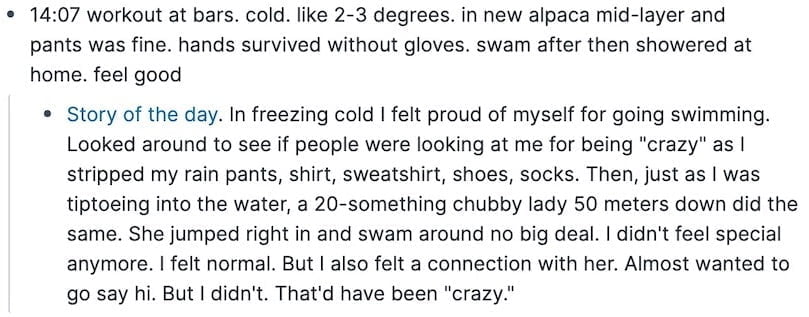
I spend the next 1 hour and 53 minutes of my day doing an [outdoor workout](https://www.thezag.com/natural-outdoor-workout-guide/) at the calisthenics park by my apartment, swimming in the ocean6, and showering at home.
- **I don’t care about micromanaging** how much time I spend getting ready to work out, walking to the park, actually working out, then showering after. One block of time is enough for me. It may even be more impactful because it shows how a “45-minute” workout can really eat up almost 2 hours.
- **I didn’t keep a detailed record of my workout.** Sometimes I do, like when I do a “[pantathlon](https://www.thezag.com/fun-hiit-workout-pantathlon/),” but generally I work out to maintain my fitness and get outside, so I don’t feel the need to carefully track my progress (or lack thereof).
- **My “Story of the Day.”** I was inspired by Matthew Dicks’ book, [Storyworthy](https://www.amazon.com/Storyworthy-audiobook/dp/B07GT7BMJV/ref=as_li_ss_tl?crid=1GULXUAA22Y6R&dchild=1&keywords=storyworthy+matthew+dicks&qid=1605033696&sprefix=storyworth,aps,216&sr=8-1&linkCode=ll1&tag=blachut-20&linkId=18ff6925042f5605dda13ecd2d4e2ec1&language=en_US), to start doing these thirteen days ago. So far, so good. It compliments my lifelogging practice really well and encourages me to keep an eye out for, and even create, the little stories in life that [make life meaningful](https://www.thezag.com/how-to-live-a-meaningful-life/) and slow down time.
## Shallow-er Afternoon
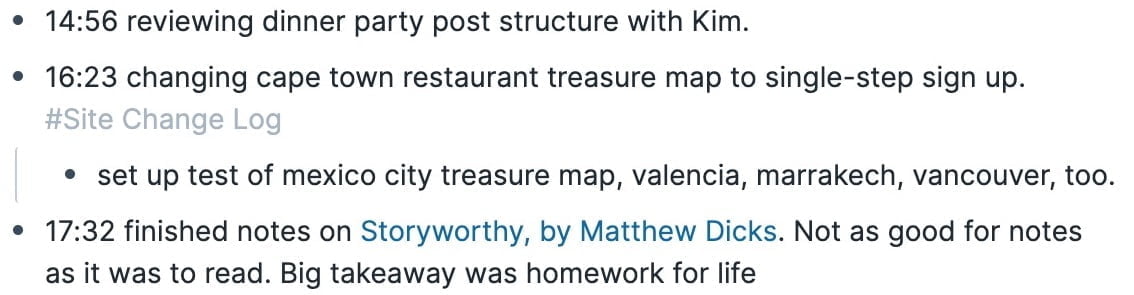
As usual, I dedicate my afternoon working hours to less demanding, “shallow” work7.
Today, it’s sitting with Kim to review a post on how to host better dinner parties she’s writing8, setting up some email capture experiments, and taking notes on the book I finished reading last week (the aforementioned [Storyworthy](https://www.amazon.com/Storyworthy-audiobook/dp/B07GT7BMJV/ref=as_li_ss_tl?crid=1GULXUAA22Y6R&dchild=1&keywords=storyworthy+matthew+dicks&qid=1605033696&sprefix=storyworth,aps,216&sr=8-1&linkCode=ll1&tag=blachut-20&linkId=18ff6925042f5605dda13ecd2d4e2ec1&language=en_US).)
- **I waste no time checking emails or social media.** If I did, I would put that in my time log. But the fact that I need to log it and see the time I’m wasting has trained me not to do so. Similarly, time logging has taught me not to multitask.
- **I’m not eating today**because I’m on Day 1 of a 5-day fast. Ever since my [first ever 3-day fast](https://www.thezag.com/3-day-fast/), I’ve tried to do a few multi-day fasts a year.
- **Hashtag links**, like # Site Change Log in the example, work the same as blue hyperlinks. So the “Site Change Log” page has a record of every instance I tag it.
## Mindless Consumption Time

By 5:32, my brain’s fried. I’ve “only” done 5 hours and 26 minutes of work and 1 hour and 40 minutes of meetings, with a 2-hour workout break.
But in my nearly two thousand days of time logging I’ve learned:
1. **That’s actually a lot.**When I started time logging, I realized most of my “working” hours weren’t spent working.
2. **Pushing myself much harder doesn’t help.**If I do, I wear myself out, sleep poorly, and am less productive
So I give into my urges to consume rather than create.
I refer to my weekly goals to see what articles and tweets I’d saved to read through and what things I wanted to Google. Since I’m fasting, I have extra time to read through any of the newsletters I’m subscribed to that tickle my fancy.
Then, when Kim’s finished her dinner, we watch a TV show before getting ready for bed.
- **Reading lists.** When I come across articles I want to read or think of topics to Google, rather than give in to my urges to do so immediately, I try to add them as to-dos on my weekly goals. Time logging has taught me to do so, as it keeps me from falling into wormholes and emerging hours later wondering where the heck all my time went.
- **No late-evening time logging.** After watching TV, I log the time, then don’t look at devices anymore, which means I don’t note when exactly I go to bed and fall asleep. My [Oura ring](https://www.thezag.com/oura-ring-review/) keeps track of that for me.

My first-ever time log from 2015. It’s evolved a lot since then. Me too.
## That’s It _(…Seems Like a Lot?)_
Now that I’ve written out this example of how I keep a time log, I realize how you might think I’m a productivity maniac. You could easily look at this and think, “Whoa, that sounds like a lot of work and stress.”
Believe me, it’s not.
If time logging was so time-consuming or stressful, I wouldn’t be on my 1,876th straight day doing it.
Also, keep in mind that I didn’t start with this whole system in place. I started simply jotting things down in Apple Notes after [being inspired by a podcast](https://www.thezag.com/lifelogging/). A year later, I migrated to [Evernote](https://evernote.com/). Now, as of June, I’ve been using [Roam](https://roamresearch.com/).9
Like the human brain, my lifelog has evolved from something simple into a magnificent organism that continues to surprise. And with it my focus, organization, structure, and output have evolved, too.
Try it. It’s worth your time.