- 34 Uplifting Things to Do Alone at Home When You Can’t Take the Boredom - [](https://www.oprahdaily.com/life/health/g22875071/things-to-do-alone/)
>But what, exactly, is play? [Generally speaking](http://www.scholarpedia.org/article/Definitions_of_Play), play is something that’s imaginative, self-directed, intrinsically motivated and guided by rules that leave room for creativity.
>“One way to think about play is an action you do that brings you a significant amount of joy without offering a specific result,” said Jeff Harry, a [positive play coach](https://www.rediscoveryourplay.com/)
[[Punished by Rewards]] links well to this; It shows how play is driven out of us in favour of a results, economic lead psychology mentality.
>## **Where Does Our Societal [[Trauma]] That Keeps Us Divided Come from?
>## Hierarchy.
How does it feel to be considered superior to someone else? How does it feel when told you are inferior? Societal friction and pain come from the concept of hierarchy.
We see the hierarchal divide in our politics, economy, and even how we relate to each other as human beings. We even measure our status based on [[Arbitrary]] hierarchal standards that objectify and disconnect us from our humanity. Hierarchy influences our daily decisions, causing us to constantly judge ourselves (and others) — fuelling an insatiable need to “win” or at least “be better” than everyone else. We, then crave even more power and status only to feel alone once we achieve it.
## Focused So Much On Winning
In our hierarchal society, we are constantly trying to win things that are unwinnable:
- Winning the day
- Winning a conversation
- Winning at work
- Winning life
We use hierarchal metrics to measure where we are on the totem pole within our communities:
- Societal Success: Net Worth & Proximity To Power
- Family Success: How Smart & Successful Are My Children & Family Members Compared To Yours
- Social Media: # of Followers & Proximity To Fame
> How much of our time in our entire life is occupied by winning and climbing the hierarchical ladder seeking validation?
What happens when we get to the top? Do we finally achieve happiness when we reach the top of validation mountain?
Michael Phelps won 28 medals in 5 Olympics, including 23 Gold Medals, and is the most decorated Olympian ever to live. As soon as his career ended, he went into a [massive depression](https://www.healthline.com/health-news/michael-phelps-my-depression-and-anxiety-is-never-going-to-just-disappear). All the outside validation and winning weren’t enough.
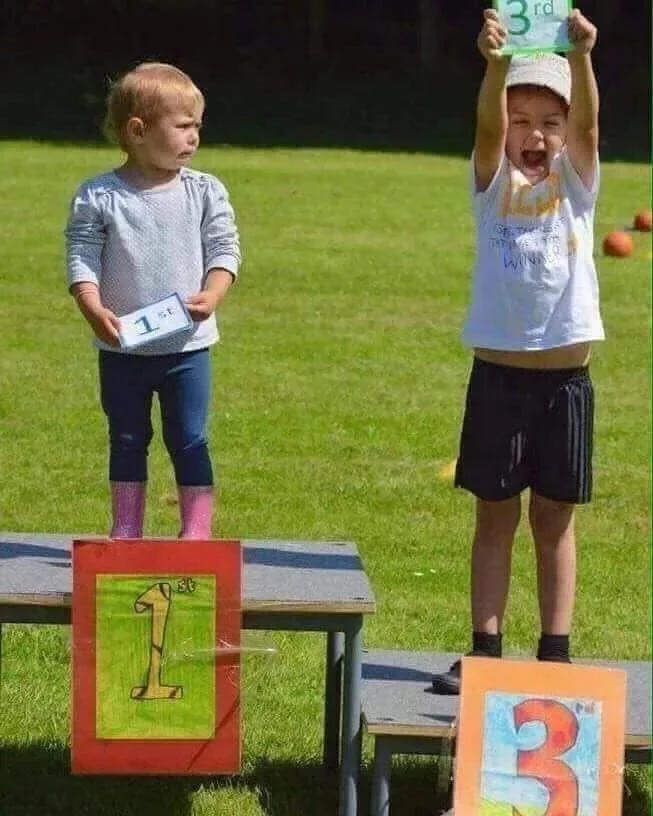
Who is the “Winner” In This Photo?
Winning is open to interpretation. Who really is the winner? There are the fabled stories of the [unlucky/lucky farmer](https://alex-65670.medium.com/the-parable-of-the-farmer-and-his-fate-54aa84006c46) or [the businessman and the fisherman](https://thestorytellers.com/the-businessman-and-the-fisherman/). Both stories are about perspective and debating what real success and winning looks like. Tom Hank even speaks about this fleeting idea of feeling successful or experiencing failure.
Some of the wealthiest people on the planet are the most miserable, constantly seeking legacy by plastering their names onto buildings, hoping someone will remember them. How many people remember [John D. Rockefeller](https://www.smithsonianmag.com/smart-news/john-d-rockefeller-richest-person-ever-live-period-180961705/) and what he stood for? He is considered the richest person ever to live and most people can’t recall what he did or who he was.
So, why do we continue to fall for this hierarchal gold rush, believing if we surpass the people around us, then we’ll be enough?
I know many people who say, “I know money doesn’t buy happiness, but I want to experience this for myself to see if it is really true.”
People continue to believe the myth that climbing the hierarchal ladder will bring them the satisfaction and the meaning that they so desire.
## What Magic Can Come From Place of Play & Curiosity
What happens when we create from a place of play and curiosity, letting go of winning?
Many people don’t know that The Wright Brothers, two bike mechanics, who ended up inventing the airplane were competing against a group of scientists lead by Andrew Langley and backed by the War Department & The Smithsonian.
[Why did the Wright Brothers Succeed Where Others Failed?](https://blogs.scientificamerican.com/observations/why-did-the-wright-brothers-succeed-when-others-failed/)
_“They weren’t trained as engineers — but they were raised to have an insatiable intellectual curiosity.”_
The goal for The Wright Brothers was not winning.
_“The greatest thing in our favor was growing up in a family where there was always much encouragement to intellectual curiosity. If my father had not been the kind who encouraged his children to pursue intellectual interests without any thought of profit, our early curiosity about flying would have been nipped too early to bear fruit.” —_ Orville Wright
They believed that if they could figure out this flying machine, it would change the course of the world.
Samuel Pierpont Langley, a Senior Officer at the Smithsonian Institute, whose network included Alexander Graham Bell and Carnegie Mellon, who was backed by $50,000 (equivalent to $2,000,000) from the War Department and a slew of scientists, was beaten out by two bike mechanics that didn’t even have engineering degrees. The pressure to win was so great that it broke him, and at the age of 71, he died.
## **Nature Even Debunks The Hierarchy Myth**
Many people speak about the idea of Alpha Males in the wild. The person that coined the term, David Mech, when studying wolves in captivity. Once he studied wolfpack in the wild, he found that there was no such thing as Alpha Males out in the wilderness, and in fact the wolfpack was run equally by the male and the female.
The concept of [Alpha Males only describes the creature’s behavior when in captivity](https://www.businessinsider.com/no-such-thing-alpha-male-2016-10). That describes the type of insecure toxic masculinity that shows up in prisons and some work environments.
Tress also debunk the hierarchical and scarcity mindset myth that they are all fighting over the same nutrients. From the show, Ted Lasso:
_“You know, we used to believe that trees competed with each other for light._ [_Suzanne Simard’s field work_](https://www.npr.org/sections/health-shots/2021/05/04/993430007/trees-talk-to-each-other-mother-tree-ecologist-hears-lessons-for-people-too)_challenged that perception, and we now realize that the forest is a socialist community. Trees work in harmony to share the sunlight.”_
**Perfection & Optimization**
Hierarchy and winning are so prevalent in Western Society that they even show up in our neighborhoods through an obsession with optimizing and perfecting. In our pursuit of perfection & optimization, we have disconnected ourselves from community and connection. A great example is Gentrification. The goal was to improve neighborhoods. Now, many gentrified neighborhoods are an amalgamation of people trying to keep up with the Joneses, void of the culture that once made that neighborhood unique. You even have transplants that move into these communities and complain about how they missed what it was like back in the day, when they were the ones that displaced the community members that made that neighborhood so distinct.
A place like New Orleans is built on community, play, and music. That is how New Orleans has been able to be so resilient, as the connections made through playing become so important during the tough times. The Second Line, done exclusively in New Orleans, even at funerals, is a way for people to celebrate someone’s life in the community.
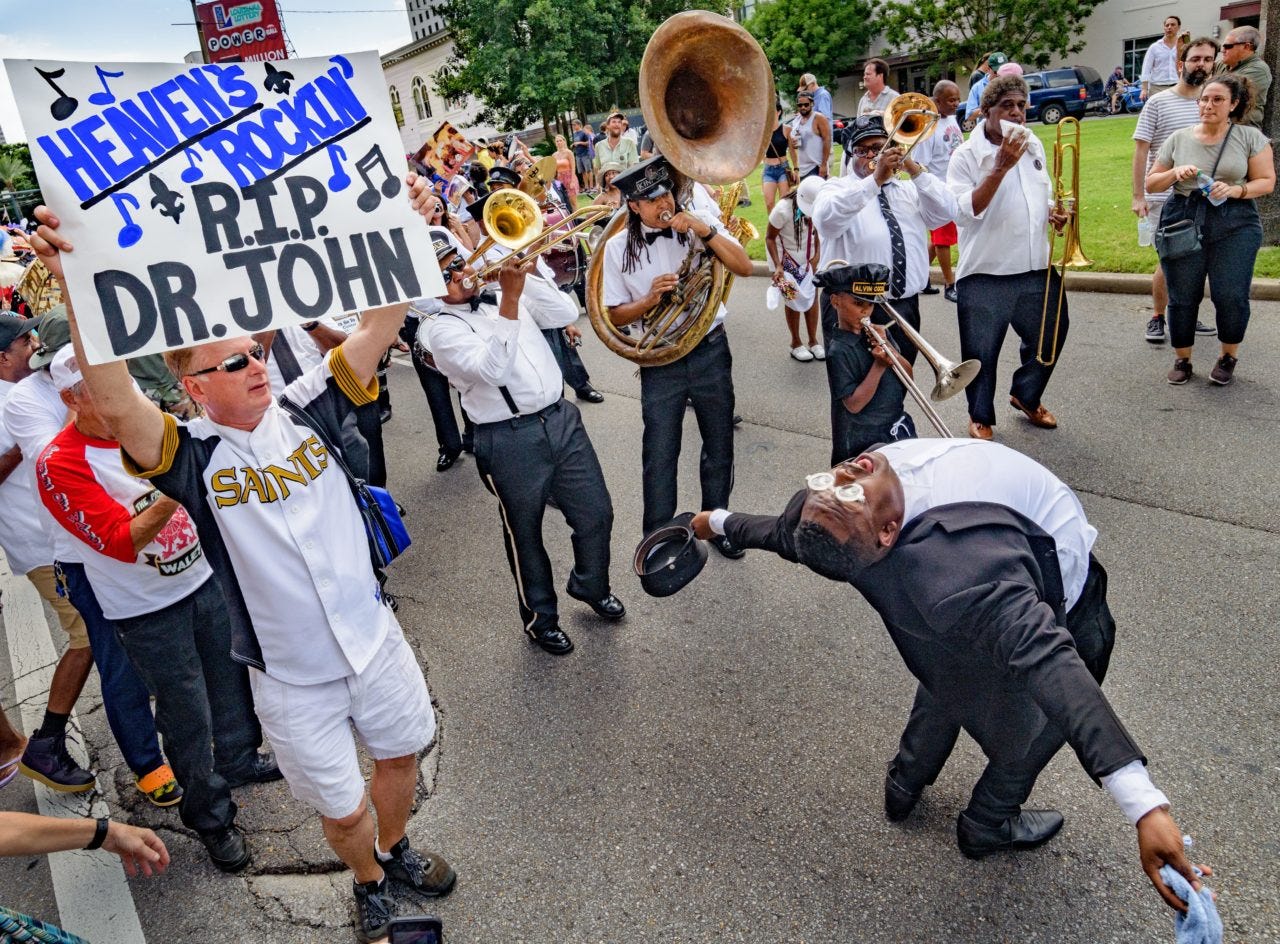
This same celebration, if done in a gentrified community, might be considered a noise nuisance.
So, if you want to bridge the divide that separates us through various power dynamics, we must learn to play with one another again.
We must be willing to be messy.
We must be willing to experiment and celebrate people’s uniqueness in our communities.
We must be willing to play and let go of the ego of trying to be superior to one another.
We must be open to experiencing the duality of putting our heart and soul into the community and letting go of the outcome.
Finally, of all the hierarchical frameworks worth exploring, the most famous is Maslow’s Hierarchy of Needs. Societies have based their entire pathway to success on this hierarchy.
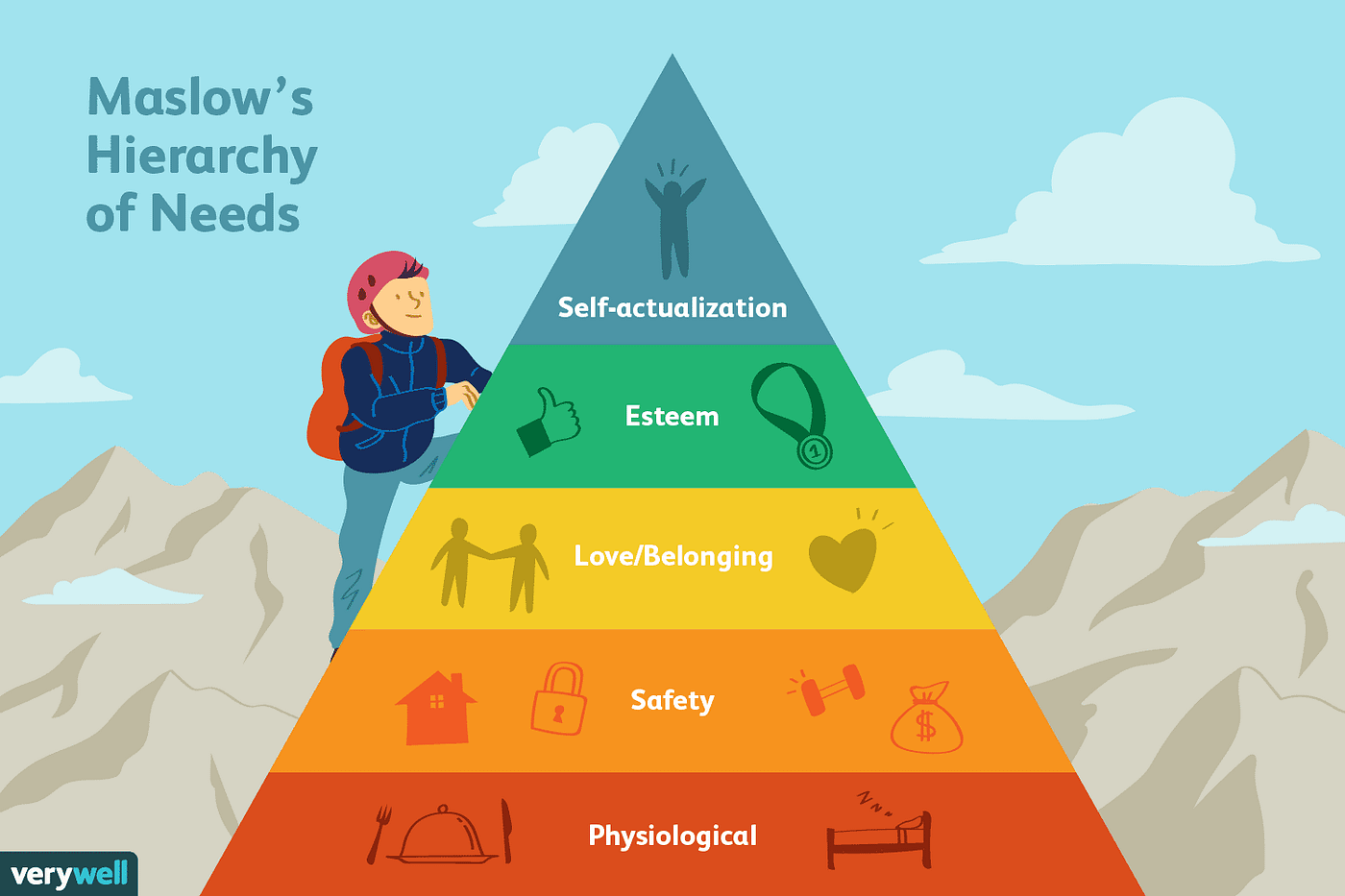
Yet, new studies have found that Maslow Hierarchy of Needs originally came from the [Blackfoote Nation’s Hierarchy of Needs](https://www.resilience.org/stories/2021-06-18/the-blackfoot-wisdom-that-inspired-maslows-hierarchy/).
_“_ [_Maslow’s Hierarchy of Needs_](https://en.wikipedia.org/wiki/Maslow%27s_hierarchy_of_needs) _may have been inspired by the Siksika (Blackfoot) way of life…Maslow spent six weeks living at_ [_Siksika_](https://siksikanation.com/) _— which is the name of the people, their language, and the Blackfoot Reserve — in the summer of 1938.”_
Abraham Maslow reinterpreted the First Nation’s Hierarchy of Needs.
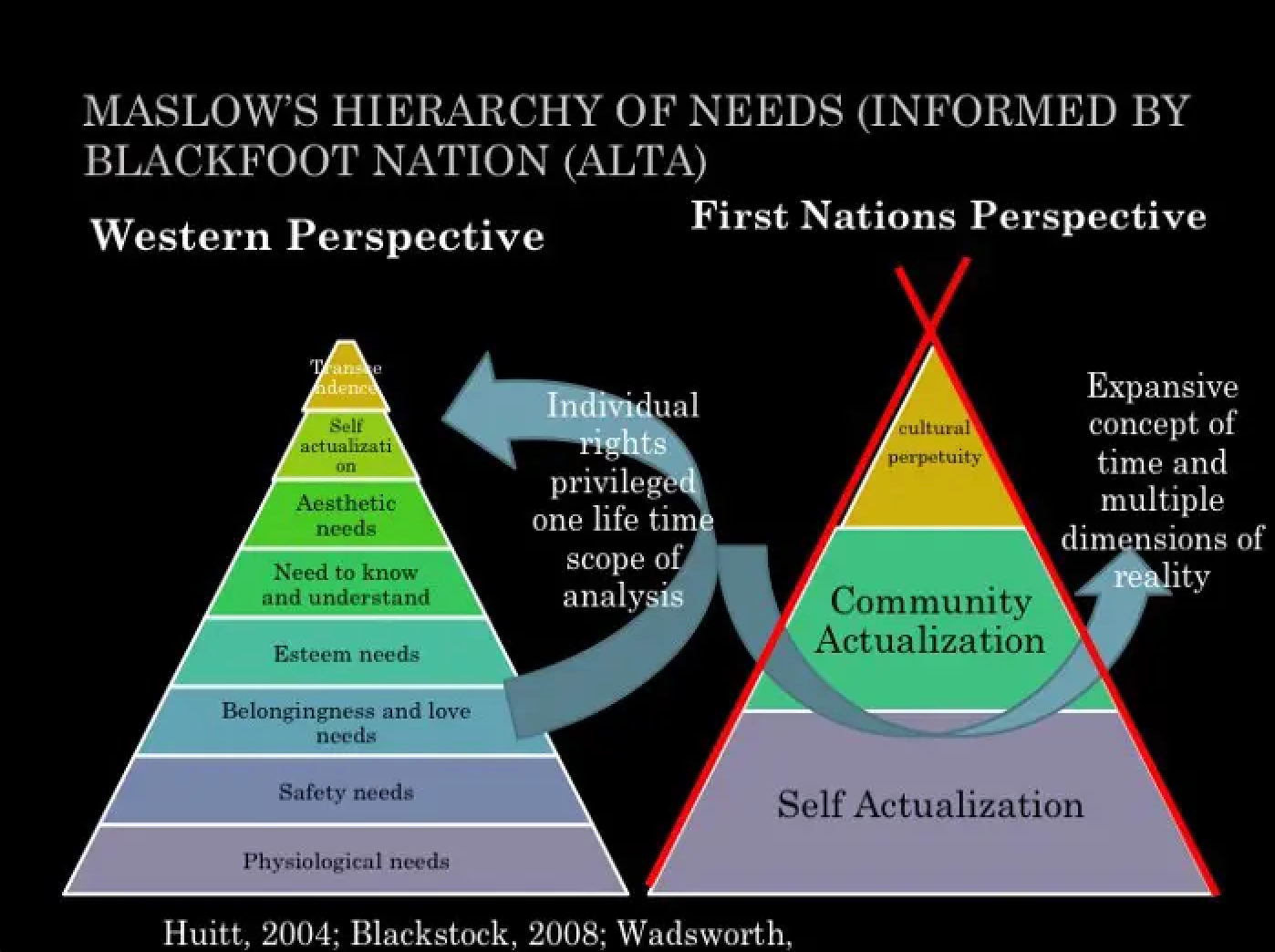
[The Blackfoot Wisdom that Inspired Maslow’s Hierarchy](https://www.resilience.org/stories/2021-06-18/the-blackfoot-wisdom-that-inspired-maslows-hierarchy/) — _Because Maslow never himself depicted his hierarchy as a pyramid (Kaufman, 2019) and the Blackfoot did not draw their worldview on a tipi (Heavy Head, 2021), this diagram should not be read as an exact comparison or as capturing the nuances of both lenses. However, it is included here to help those of us mired in Western thinking see the different emphasis of First Nations perspectives._
Maslow placed self-actualization at the top, while the First Nations perspective saw self-actualization as the bare minimum to begin from.
**Self Actualization**
Self-actualization means realizing your dreams, being true to yourself, and achieving inner peace was what you initially did for yourself—figuring out how you want to show up in the world.
**Community Actualization**
How do you show up as a community? How do you show up as [WE rather than just as ME](https://youtu.be/aK8sWv4jHaE?t=430)? For the Blackfoote Nation, poverty didn’t exist because if one tribal member suffered, the entire tribe does. If someone was going through depression, it was the community's responsibility to help. The community helped individuals carry their burdens and their pain.
Part of the reason why depression is so high in Western Society is that it is considered an individual problem instead of recognizing what role the collective community play.
There is a story of a village in a developing country in [[Africa]] that experienced a major catastrophe, and the Red Cross provided Western Psychologists to help heal trauma. After a few days, the psychologists were kicked out of the village. The villagers said that their Western methods were not helping. The psychologists were told:
- We heal in community
- We heal through dance
- We heal outside
- We heal together
Your way has us inside a dark room, discussing our issues in isolation, and providing major antidepressants to alleviate the pain. That is not helpful.
Community actualization is about embracing WE over ME. Choosing to have the community help carry the burden so we don’t feel alone. That is another way of dismantling hierarchy, but recognizing someone’s suffering is all our suffering.
[
## Embrace Your Fears: We, Not Me
### Sara Surani @sarasurani & I run a workshop about Embracing Your Fears from a place of We, Not Me. We realized that fear…
youtube.com
](https://youtube.com/shorts/BQyFzsBih7o?feature=share)
**Cultural Perpetuity**
From Karen Lincoln Michel’s article, [Maslow’s hierarchy connected to Blackfoot beliefs](https://lincolnmichel.wordpress.com/2014/04/19/maslows-hierarchy-connected-to-blackfoot-beliefs/), Cultural Perpetuity means “breath of life.”
_“We have been given the ancestors’ teachings and the feelings and the spirit. We can do a couple of things with that. We can say that what we know is inadequate and that we’re not Indian enough, and that we don’t know enough about it, or we don’t want to pass it on. And we hold our breath, and our people stop. Or you can nourish that breath. You can breathe in even deeper the knowledge of others and understand it at a deep level and then breathe it forward. That’s the breath of life,” — Cindy Blackstock_
Cindy went on to say:
_First Nations often consider their actions in terms of the impacts of the “seven generations.” This means that one’s actions are informed by the experience of the past seven generations and by considering the consequences for the seven generations to follow._
Based on this idea, your individual life, the 70–100 years you live, is insignificant. At the same time, you are the crucial link, the breath of life, that chooses what to pass on to future generations, from historical trauma to lessons learned. That makes you so vital to the larger picture. You are one vital block that helps build the cathedral.
I speak about this cathedral effect as would you want to help build a cathedral if you couldn’t see it completed. Nowadays, everyone wants to build their own and see the results in their lifetime.
> What if you could build something even more special, being apart of something much bigger than yourself, but you don’t get to see its completion? Would you do it?
Positive Psychology's main motto is “other people matter.”
Improv's main goal is to “make your partner look great.” That is why their play is Yes And…instead of No…But.
We have significant issues to solve in the next two decades. From climate change to out-of-control gun violence to mending our current political divide. Hierarchies are designed to keep us apart from having the [difficult conversations necessary](https://jeffharryplays.medium.com/i-had-a-conversation-with-a-trump-supporter-to-try-to-find-common-ground-it-lasted-3-hours-a3a7d4736b8) to start to heal the division between us.
When we come from a place of play and de-platform a unitary/singular form of success, we can break down the egoic outer self and instead, connect with each other’s inner child.
We are so scared of failing that we don’t even try right now. Ironically, we need to be failing more and choosing to quit less.
We must recognize that we have been dealing with a collective [[Trauma]], especially these last few years.
The essence of [[Trauma]] is fragmentation. Where there is rupture, the impact on [[Trauma]] is avoidance. That is what is happening now, as we avoid one another. To repair this, we must be fully present. We must be willing to try, fail, experiment, and simply play.
We are just like those soldiers on that Christmas battlefield. We want to connect. We want this battle to be over. We want a different scenario to exist, but we don’t have any clue how to get out of the muck to get there.
But all it takes is one person… one person looking for attunement through play, and whoever responds to this in kind. That is when we begin to dismantle the hierarchy concept because we are no longer trying to win.
We are finally willing to put down our weapons of divisiveness and hierarchy because we recognize we are the same.
[
Play
](https://medium.com/tag/play?source=post_page-----14c0cd7f6cc7---------------play-----------------)
[
Patriarchy
](https://medium.com/tag/patriarchy?source=post_page-----14c0cd7f6cc7---------------patriarchy-----------------)
[
Hierarchy
](https://medium.com/tag/hierarchy?source=post_page-----14c0cd7f6cc7---------------hierarchy-----------------)
[
Healing
](https://medium.com/tag/healing?source=post_page-----14c0cd7f6cc7---------------healing-----------------)
[
Political Divide
](https://medium.com/tag/political-divide?source=post_page-----14c0cd7f6cc7---------------political_divide-----------------)
>Without this playing with fantasy no creative work has ever yet come to birth. The debt we owe to the play of imagination is incalculable.
Carl Gustav Jung
Psychological Types, 1923
- playing with kids can feel hard because you think they want to play by running around. But what if you play so they use their minds and imaginations?
#Art
Have a look